Major David EILENBERG
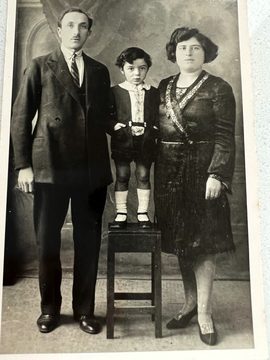
Parents
- Syne Szymon EILENBERG 1895-1986
- Annie SHUBE 1898-1966
Union(s) et enfant(s)
-
Marié le 18 novembre 1955 (vendredi), Hendon, NW4 4EF, Londres, Angleterre, ROYAUME-UNI, avec
Elizabeth Joan ROTHWELL 1924-2013
dont
- Fiche privée
- Nigel Paul EILENBERG 1959-2011
- Fiche privée
Frères et sœurs
- Major David EILENBERG 1925-2012
- Eilena EILENBERG 1930-2008
Événements
- 18 août 1925 :
- Naissance - Stepney, E1 3DH, Londres, Angleterre, ROYAUME-UNI
- 18 novembre 1955 :
- Mariage (avec Elizabeth Joan ROTHWELL) - Hendon, NW4 4EF, Londres, Angleterre, ROYAUME-UNI
- 6 février 2012 :
- Décès - Auckland, NOUVELLE-ZÉLANDE
Notes
{\rtf1\ansi\ansicpg1252\cocoartf2636
\cocoatextscaling0\cocoaplatform0{\fonttbl\f0\fswiss\fcharset0 ArialMT;\f1\fnil\fcharset0 AvenirNextCondensed-Regular;}
{\colortbl;\red255\green255\blue255;\red49\green62\blue69;\red255\green255\blue255;}
{\*\expandedcolortbl;;\cssrgb\c25098\c30980\c34118;\cssrgb\c100000\c100000\c100000;}
\pard\tx560\tx1120\tx1680\tx2240\tx2800\tx3360\tx3920\tx4480\tx5040\tx5600\tx6160\tx6720\pardirnatural\partightenfactor0
{\field{\*\fldinst{HYPERLINK "https://history.rcplondon.ac.uk/inspiring-physicians/major-david-eilenberg"}}{\fldrslt
\f0\fs20 \cf0 https://history.rcplondon.ac.uk/inspiring-physicians/major-david-eilenberg}}
\f0\fs20 \
\
\pard\tx560\tx1120\tx1680\tx2240\tx2800\tx3360\tx3920\tx4480\tx5040\tx5600\tx6160\tx6720\pardirnatural\partightenfactor0
\f1\fs24 \cf0 Eilenberg was a consultant psychiatrist, first at Northwick Park Hospital, Harrow, and then in Auckland, New Zealand, where he emigrated in 1975. He was an exceptionally able clinician with administrative ability and an intense interest in medical ethics. He was born in Pitsea, Essex, the older of the two children of Sidney Eilenberg, a confectioner, and Annie Eilenberg n\'e9e Shube. Sidney Eilenberg went to England from Poland in 1915. His wife and her parents had arrived fromPoland some years earlier. Major, a name deliberatively chosen by his father for its distinctiveness and which caused lifelong confusion with the military rank, was educated at Hackney Downs School, a London County Council grammar school formerly the Grocers\'92 Company\'92s School. The school\'92s alumni include Steven Berkoff, Michael Caine and Harold Pinter, among many other notable men. Eilenberg graduated from the London Hospital Medical School in 1949.\
After house officer appointments at the London Hospital, Eilenberg did his National Service in the medical branch of the RAF (from 1953 to 1955), serving in the Middle East with the rank of squadron leader. He then became a registrar and a senior registrar at the Maudsely Hospital, from 1955 to 1961. The Maudsley was the specialist NHS hospital which, in partnership with the Institute of Psychiatry, provided training in psychiatry for United Kingdom and some Commonwealth graduates. The Maudsley was then the world\'92s leading postgraduate school of psychiatry. Eilenberg flourished. He published, as an author or co-author, 10 papers based on research conducted during his training, a remarkable achievement for a junior doctor. Two papers were particularly notable: a study of 1,200 emergency psychiatric admissions over one year to an observation ward (Eilenberg MD, Pritchard MJ, Whatmore PB. \'91A 12-month survey of observation ward practice\'92. Br J Prev Soc Med. 1962 16:22-9) and a comparison of 1930 and 1955 admissions to Stamford House, a boys\'92 remand centre (Eilenberg MD. \'91Remand home boys\'92. British J Criminology 1961 Oct 111-131). Prominent in both are his interest in medical aspects of psychiatry and the importance of administration in providing health care. His other papers reported controlled drug trials, case reports, neurophysiology of ECT and the prognosis of neurosis in pregnancy.\
To broaden his experience, Eilenberg spent a year (from 1961 to 1962) at the Mayo Clinic as a staff psychiatrist. From there he published three papers, one on liaison psychiatry, showing his developing interest in this specialty (Eilenberg MD. \'91Survey of in-patient referrals to an American psychiatric department\'92. Br J Psychiatry 1965 111 1211-4). He joined the Mayo Clinic chapter of Sigma Xi, a society dedicated to promoting integrity in science and engineering.\
Eilenberg returned to England to be a consultant psychiatrist, first at Wembley Hospital (from 1963 to 1970) and then at Shenley and Northwick Park hospitals (from 1970 to 1974). At Shenley he was a member of the hospital management committee. He was also a member of the North-West Metropolitan Regional Hospital Board (from 1970 to 1974).\
Northwick Park Hospital was established in 1970 jointly by the NHS and the Medical Research Council (MRC) to provide for clinical research. Here Eilenberg became a key figure in establishing the new NHS psychiatric service and ensuring its cooperation with the MRC Clinical Research Centre, where TJ Crow was appointed by the MRC as head of their division of psychiatry in January 1974. Such was Eilenberg\'92s stature that he became chairman of the ethical committee for Northwick Park Hospital,a committee that played a key role in facilitating clinical research across all disciplines. A British Medical Journal sponsored discussion on the ethics of clinical research between Eilenberg, LJ Witts, Nuffield Professor of Medicine at Oxford, and R Williams, director of liver research at King\'92s College Hospital, shows Eilenberg\'92s grasp of the principle issues (\'91New horizons in medical ethics: research investigations in adults\'92. BMJ 1973 2[5860] 220-4). Essentially Eilenberg argued for promoting a culture of ethical concern among all professions involved in clinical research.\
In 1974, to the astonishment of his colleagues, Eilenberg said he and his family were moving to Auckland, New Zealand, as he put it, \'91to go back 50 years in time\'92. They arrived on New Year\'92s Day 1975. The upper age for permanent migration to New Zealand was then 45 years. Eilenberg was 49. Because of his distinction an exception was made and he was appointed director of the division of psychiatry at Auckland Hospital. His superior clinical ability, grasp of medical administration and mentorship were appreciated. And his advice on psychiatric aspects of medical and especially neurological illness was sort after. He retired from his hospital post in 1985 to work part-time in the geriatric unit at Auckland Hospital as a valued liaison psychiatrist until 2002.\
He was a clinical teacher in Auckland\'92s Medical School. He had also a private consulting practice at the Bexley Clinic in Auckland, where he continued until 2008.\
After his death a colleague, who had known him since 1975, remarked, \'91He made an enormous contribution to Auckland psychiatry in both the formal training of young psychiatrists and as a role model for new consultants, encouraging participation in administration, service delivery and negotiation with management.\'92\
Eilenberg\'92s chief interest, outside his family, was golf. His regret was not to have gone to Auckland 10 years earlier.\
In 1955 Eilenberg married Elizabeth Joan Rothwell, a senior charge nurse at the London Hospital and daughter of Frederick Rothwell, vicar of Denmead, Hampshire. Eilenberg was survived by Elizabeth and their two sons, Richard, a dentist, and Philip,an accountant. A third child, Nigel, died in 2011.\
Brian Barraclough\
\
\'97\'97\'97\'97\'97\'97\'97\'97\'97\'97\'97\'97\'97\'97\'97\'97\'97\'97\
\
Eilenberg \'e9tait psychiatre consultant, d'abord \'e0 l'h\'f4pital Northwick Park de Harrow, puis \'e0 Auckland, en Nouvelle-Z\'e9lande, o\'f9 il a \'e9migr\'e9 en 1975. Il \'e9tait un clinicien exceptionnellement comp\'e9tent, dot\'e9 de capacit\'e9s administratives et d'un int\'e9r\'eat intense pour l'\'e9thique m\'e9dicale. Il est n\'e9 \'e0 Pitsea, Essex, l'a\'een\'e9 des deux enfants de Sidney Eilenberg, confiseur, et d'Annie Eilenberg n\'e9e Shube. Sidney Eilenberg a quitt\'e9 la Pologne pour l'Angleterre en 1915. Sa femme et ses parents \'e9taient arriv\'e9s de Pologne quelques ann\'e9es plus t\'f4t. Major, un nom d\'e9lib\'e9r\'e9ment choisi par son p\'e8re pour son caract\'e8re distinctif et qui a longtemps caus\'e9 une confusion avec le grade militaire, a fait ses \'e9tudes \'e0 la Hackney Downs School, une \'e9cole secondaire du London County Council, anciennement la Grocers' Company's School. Les anciens \'e9l\'e8ves de l'\'e9cole comprennent Steven Berkoff, Michael Caine et Harold Pinter, parmi de nombreux autres hommes notables. Eilenberg est dipl\'f4m\'e9 de la London Hospital Medical School en 1949.\
\
Apr\'e8s avoir \'e9t\'e9 nomm\'e9 officier de maison \'e0 l'h\'f4pital de Londres, Eilenberg a effectu\'e9 son service national dans la branche m\'e9dicale de la RAF (de 1953 \'e0 1955), servant au Moyen-Orient avec le grade de chef d'escadron. Il devient ensuite registraire et registraire principal \'e0 l'h\'f4pital Maudsely, de 1955 \'e0 1961. Le Maudsley \'e9tait l'h\'f4pital sp\'e9cialis\'e9 du NHS qui, en partenariat avec l'Institut de psychiatrie, dispensait une formation en psychiatrie aux dipl\'f4m\'e9s du Royaume-Uni et du Commonwealth. Le Maudsley \'e9tait alors la premi\'e8re \'e9cole postuniversitaire de psychiatrie au monde. Eilenberg a prosp\'e9r\'e9. Il a publi\'e9, en tant qu'auteur ou co-auteur, 10 articles bas\'e9s sur des recherches men\'e9es au cours de sa formation, une r\'e9ussite remarquable pour un jeune docteur. Deux articles \'e9taient particuli\'e8rement remarquables\'a0: une \'e9tude de 1 200 admissions psychiatriques d'urgence sur un an dans un service d'observation (Eilenberg MD, Pritchard MJ, Whatmore PB. 'A 12-month Survey of Observation War Practice'. Br J Prev Soc Med. 1962 16 : 22-9) et une comparaison des admissions de 1930 et 1955 \'e0 Stamford House, un centre de d\'e9tention provisoire pour gar\'e7ons (Eilenberg MD. 'Remand home boys'. British J Criminology 1961 Oct 111-131). Dans les deux cas, son int\'e9r\'eat pour les aspects m\'e9dicaux de la psychiatrie et l'importance de l'administration dans la prestation des soins de sant\'e9 est important. Ses autres articles rapportaient des essais contr\'f4l\'e9s de m\'e9dicaments, des rapports de cas, la neurophysiologie de l'ECT et le pronostic de la n\'e9vrose pendant la grossesse.\
\
Pour \'e9largir son exp\'e9rience, Eilenberg a pass\'e9 un an (de 1961 \'e0 1962) \'e0 la clinique Mayo en tant que psychiatre. De l\'e0, il publia trois articles, dont un sur la psychiatrie de liaison, d\'e9montrant son int\'e9r\'eat croissant pour cette sp\'e9cialit\'e9 (Eilenberg MD. \'ab Survey of in-patient references to an American psychiatric d\'e9partement \'bb. Br J Psychiatry 1965 111 1211-4). Il a rejoint la section Mayo Clinic de Sigma Xi, une soci\'e9t\'e9 d\'e9di\'e9e \'e0 la promotion de l'int\'e9grit\'e9 dans les sciences et l'ing\'e9nierie.\
\
Eilenberg est retourn\'e9 en Angleterre pour devenir psychiatre consultant, d'abord \'e0 l'h\'f4pital de Wembley (de 1963 \'e0 1970), puis aux h\'f4pitaux de Shenley et de Northwick Park (de 1970 \'e0 1974). \'c0 Shenley, il \'e9tait membre du comit\'e9 de gestion de l'h\'f4pital. Il a \'e9galement \'e9t\'e9 membre du conseil d'administration de l'h\'f4pital r\'e9gional m\'e9tropolitain du Nord-Ouest (de 1970 \'e0 1974).\
\
L'h\'f4pital Northwick Park a \'e9t\'e9 cr\'e9\'e9 en 1970 conjointement par le NHS et le Medical Research Council (MRC) pour assurer la recherche clinique. Ici, Eilenberg est devenu un personnage cl\'e9 dans la cr\'e9ation du nouveau service psychiatrique du NHS et a assur\'e9 sa coop\'e9ration avec le Centre de recherche clinique du MRC, o\'f9 TJ Crow a \'e9t\'e9 nomm\'e9 par le MRC \'e0 la t\'eate de leur division de psychiatrie en janvier 1974. La stature d'Eilenberg \'e9tait telle qu'ilest devenu pr\'e9sident du comit\'e9 d'\'e9thique de l'h\'f4pital Northwick Park, un comit\'e9 qui a jou\'e9 un r\'f4le cl\'e9 en facilitant la recherche clinique dans toutes les disciplines. Une discussion parrain\'e9e par le British Medical Journal sur l'\'e9thique de la recherche clinique entre Eilenberg, LJ Witts, professeur de m\'e9decine Nuffield \'e0 Oxford, et R Williams, directeur de la recherche sur le foie au King's College Hospital, montre la compr\'e9hension d'Eilenberg des principales questions (\'ab De nouveaux horizons dans \'e9thique m\'e9dicale\'a0: recherches sur les adultes". BMJ 1973 2[5860] 220-4). Eilenberg plaidait essentiellement en faveur de la promotion d\'92une culture de pr\'e9occupation \'e9thique parmi toutes les professions impliqu\'e9es dans la recherche clinique.\
\
En 1974, au grand \'e9tonnement de ses coll\'e8gues, Eilenberg a d\'e9clar\'e9 que lui et sa famille allaient d\'e9m\'e9nager \'e0 Auckland, en Nouvelle-Z\'e9lande, comme il le disait, \'ab pour remonter 50 ans en arri\'e8re \'bb. Ils sont arriv\'e9s le jour du Nouvel An 1975. L\'92\'e2ge sup\'e9rieur pour la migration permanente vers la Nouvelle-Z\'e9lande \'e9tait alors de 45 ans. Eilenberg avait 49 ans. En raison de sa distinction, une exception fut faite et il fut nomm\'e9 directeur de la division de psychiatrie de l'h\'f4pital d'Auckland. Ses capacit\'e9s cliniques sup\'e9rieures, sa compr\'e9hension de l'administration m\'e9dicale et son mentorat ont \'e9t\'e9 appr\'e9ci\'e9s. Et ses conseils sur les aspects psychiatriques des maladies m\'e9dicales et surtout neurologiques \'e9taient tr\'e8s appr\'e9ci\'e9s. Il a pris sa retraite de son poste hospitalier en 1985 pour travailler \'e0 temps partiel dans l'unit\'e9 g\'e9riatrique de l'h\'f4pital d'Auckland en tant que psychiatre de liaison appr\'e9ci\'e9 jusqu'en 2002.\
\
Il \'e9tait professeur de clinique \'e0 la facult\'e9 de m\'e9decine d\'92Auckland. Il avait \'e9galement un cabinet de conseil priv\'e9 \'e0 la Bexley Clinic d'Auckland, o\'f9 il a continu\'e9 jusqu'en 2008.\
Apr\'e8s sa mort, un coll\'e8gue qui le connaissait depuis 1975 a d\'e9clar\'e9 : \'ab Il a apport\'e9 une \'e9norme contribution \'e0 la psychiatrie d'Auckland, \'e0 la fois dans la formation formelle des jeunes psychiatres et comme mod\'e8le pourles nouveaux consultants, encourageant la participation \'e0 l'administration, \'e0 la prestation de services et \'e0 la n\'e9gociation. avec la direction.\
Le principal int\'e9r\'eat d\'92Eilenberg, en dehors de sa famille, \'e9tait le golf. Son regret \'e9tait de ne pas \'eatre all\'e9 \'e0 Auckland dix ans plus t\'f4t.\
En 1955, Eilenberg \'e9pousa Elizabeth Joan Rothwell, infirmi\'e8re principale \'e0 l'h\'f4pital de Londres et fille de Frederick Rothwell, vicaire de Denmead, Hampshire. Eilenberg laisse dans le deuil Elizabeth et leurs deux fils, Richard, dentiste, et Philip, comptable. Un troisi\'e8me enfant, Nigel, est d\'e9c\'e9d\'e9 en 2011.\
\
\
{\field{\*\fldinst{HYPERLINK "https://notices.nzherald.co.nz/nz/obituaries/nzherald-nz/name/major-eilenberg-obituary?id=41998695"}}{\fldrslt https://notices.nzherald.co.nz/nz/obituaries/nzherald-nz/name/major-eilenberg-obituary?id=41998695}}\
\
\pard\pardeftab720\ri-6855\qj\parhyphenfactor20\partightenfactor0
\cf2 \cb3 \expnd0\expndtw0\kerning0
EILENBERG, Major David. Passed away peacefully at Cornwall Park Hospital on Monday 6 December 2012. Loving husband of Elizabeth for 56 wonderful years. To my beloved Major, I will always treasure the memories of our time together, the laughter we shared, the kisses and holding hands. you were my life, husband and best friend. Rest in peace darling. Your everloving wife, Elizabeth.\cb1 \
\cb3 Published by The New Zealand Herald on Feb. 9, 2012.\cf0 \cb1 \kerning1\expnd0\expndtw0 \
\pard\tx560\tx1120\tx1680\tx2240\tx2800\tx3360\tx3920\tx4480\tx5040\tx5600\tx6160\tx6720\pardirnatural\partightenfactor0
\cf0 \
}